The Window of Tolerance
The Window of Tolerance describes the range of internal states within which you can function effectively—thinking clearly, feeling emotions without being overwhelmed, and responding intentionally rather than reactively.
When you’re within your window, your thinking brain (prefrontal cortex) and autopilot brain (limbic system) are in balance. Outside that window, your autopilot brain temporarily takes over to protect you.
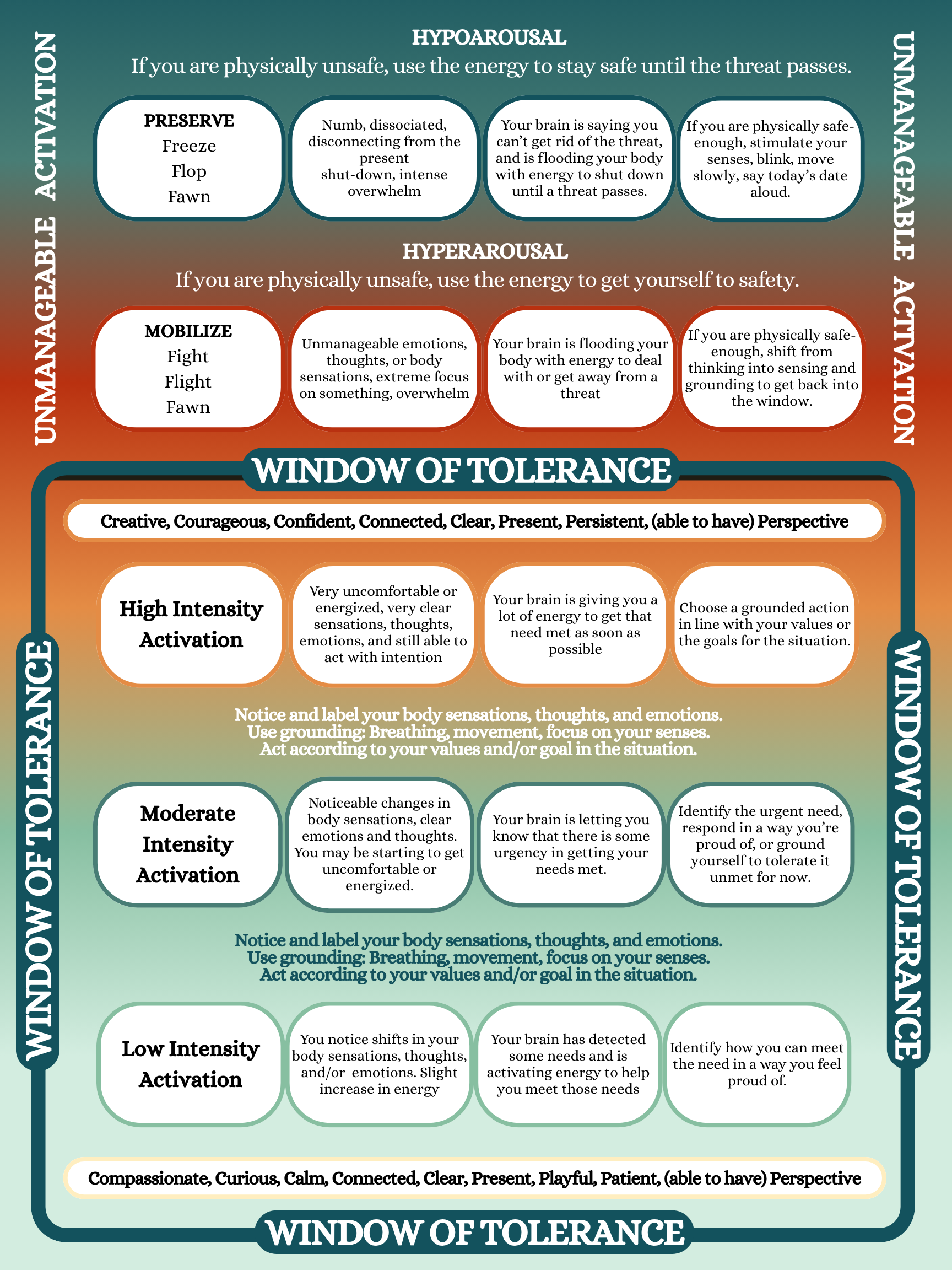
Inside the Window: Manageable Activation
When you’re inside your window, you experience manageable activation—your body and mind are working together to meet your needs in a grounded, intentional way.
Low-intensity activation
You may notice subtle changes—slight increases in energy, small shifts in emotion or body sensation.
Your brain has detected a need and is sending gentle signals to help you respond.
Helpful action: Identify what need is emerging and meet it in a way that aligns with your values.
Example: You feel a bit restless before a meeting—your body might be asking for movement or focus. You stretch or take a mindful breath, and the system settles.
Moderate-intensity activation
The signals are stronger—clear thoughts, emotions, and sensations arise.
You might feel slightly uncomfortable, agitated, or motivated to act.
Helpful action: Identify the need that feels urgent. Respond in a way you’re proud of, or ground yourself if the need can’t be met right away.
Example: You feel frustrated during a conversation. You recognize the need for respect or understanding and choose to pause or communicate clearly.
High-intensity activation
Your brain is giving you a lot of energy to meet a need now.
Emotions and sensations are very strong, and you can still act intentionally.
Helpful action: Choose a grounded, values-aligned action that matches your goals for the situation.
Example: You feel anxious before giving a talk. You use slow breathing and focus on why the message matters to stay present while channeling the extra energy.
Out of the Window: Hyperarousal (Mobilize Response)
When the brain perceives a serious threat, it floods the body with energy to fight, flee, or fawn. This is your MOBILIZE response.
You may feel overwhelmed, agitated, panicked, or intensely focused on escaping or fixing something.
Thoughts may race; it might feel like your brain has weaponized your intellect in a way. Your body sensations are usually very intensely energized and uncomfortable.
If you are physically unsafe, that energy helps you get to safety.
If you are safe enough, you can shift from thinking to sensing: breathe, ground, feel your body.
Goal: Reconnect with your senses to signal safety to your nervous system and re-enter your window.
Out of the Window: Hypoarousal (Preserve Response)
When the brain decides a threat cannot be escaped, it shifts into shutdown mode—the PRESERVE response.
You may feel numb, detached, frozen, or disconnected from the present.
This protects you by conserving energy until the danger passes.
If you are physically unsafe, that energy helps you stay still and minimize danger.
If you are safe enough, stimulate your senses gently—blink, move slowly, say the date aloud—to bring your system back online.
Goal: Re-engage your body and your immediate surroundings in the present moment to help your body sense you are safe-enough and return to your window.
The Goal: Flexible Regulation, Not Constant Calm
Being “regulated” doesn’t mean staying calm all the time—it means being able to notice, name, and navigate your internal states. The goal is not to avoid activation but to learn how to move through it with awareness.
When you’re in your window, you tend to feel:
Compassionate, Creative, Curious, Confident, Courageous, Calm, Connected, Clear, Present, Persistent, Playful, Patient, and able to hold Perspective.
These are signs that both your survival and thinking systems are working together.
Learning to Recognize When You’re In (or Out of) Your Window
One of the most powerful mental health skills you can build is learning to notice when you’re inside or outside your window of tolerance. Most of us don’t realize we’ve shifted until after we’ve reacted, shut down, or spiraled. That’s normal — your autopilot brain is designed to act fast to keep you safe.
Over time, though, you can train your thinking brain to catch these shifts earlier.
-
You’re likely in your window when you can:
Feel emotions without being swept away by them
Think clearly and problem-solve
Communicate or make decisions intentionally
Stay connected to your body sensations (noticing, not overwhelmed)
Recover from stress relatively quickly
You might describe this state as calm enough, clear enough, connected enough.
-
You might notice:
Sudden tension, shallower breathing, or holding your breath
Racing thoughts or blank mind
Feeling the urge to act, fix, or escape
Feeling emotionally flooded, or going flat and disconnected
Losing track of time or surroundings
Difficulty taking in new information
When you notice these, your brain is signaling that something feels too much or too fast. This isn’t a failure — it’s an invitation to pause and respond with care.
-
When you’re in hyperarousal, your body is saying “we need to act now.”
This state brings up intense energy and focus that are meant to help you survive — but if you’re safe enough, that same energy can be gently guided back into balance.Signs of Hyperarousal
Racing heart, rapid breathing, shaking
Feeling trapped or needing to run away
Overthinking or obsessing about what to do
Anger, panic, or explosive tears
Feeling out of control or not safe-enough in your own body
Trouble listening or calming down even after reassurance
If You’re Physically Safe-Enough: Grounding Actions
Choose actions that slow, anchor, and soften your body and mind.
Physical Grounding
Take 3–5 slow, deliberate breaths (long exhale > inhale)
Feel your feet press into the ground or your back against a chair
Use vivid sensations to anchor: hold an ice cube, splash cool water, wrap in a weighted blanket, put a strong mint or flavor in your mouth
Try “5-4-3-2-1 grounding”: name 5 things you see, 4 things you can touch, 3 you can hear, 2 you can smell, 1 you can taste
Move slowly: gentle stretching, walking, shaking out limbs
Cognitive Grounding
Name what’s happening: “My body is on high alert, but I am safe enough right now.”
Orient to the present: say the date, your name, where you are
Use affirmations that re-establish safety: “This is a moment of intensity, not danger.”
Visualize a safe or calm place you’ve experienced
Emotional Soothing
Place a hand over your heart or chest and breathe into it
Soften your jaw and shoulders
Turn down stimulation: dim lights, reduce noise, limit screens
Seek co-regulation: talk to someone calm, look at a comforting photo, or hold a pet
Listen to slow, low-tempo music or soothing voices
The goal isn’t to “force calm,” but to help your body know it’s safe enough to stand down.
-
When you’re in hypoarousal, your body is saying “we can’t do this anymore — let’s conserve.”
You might feel numb, foggy, disconnected, or unable to act. This state protects you from overwhelm but can make you feel stuck or invisible.Signs of Hypoarousal
Numbness, emptiness, or feeling “far away”
Slowed breathing or movement
Heavy limbs or fatigue
Flat affect or monotone voice
Difficulty focusing or responding
Feeling detached from self or surroundings
If You’re Physically Safe-Enough: Reconnecting Actions
Choose actions that gently wake up and re-engage your senses and energy.
Physical Re-Engagement
Move your body gradually: stretch, sway, or walk
Feel texture and temperature (run hands under warm water, hold a mug)
Blink slowly and notice colors, shapes, and light around you
Clap, tap your arms or legs, or bounce lightly to reintroduce movement
Eat or drink something with strong flavor or temperature contrast
Cognitive Orientation
Say out loud: “It’s [day/date/time]. I’m safe enough right now.”
Describe your surroundings in detail (“I’m sitting on a blue chair in my office…”)
Count backward by 3s or recite song lyrics to re-engage the thinking brain
Visualize turning a dimmer switch slowly back up—more light, more aliveness
Emotional Connection
Look at something or someone that evokes warmth
Listen to upbeat or emotionally meaningful music
Engage in small, predictable tasks: folding laundry, watering plants
Reach out to a trusted person, even if it’s just to say “Can you help me come back?”
Remind yourself: “This is my body protecting me. I can return gently.”
The goal isn’t to snap out of it, but to rebuild connection slowly—to help your brain remember that presence is safe.
Expanding the Window
Our Window of Tolerance can become smaller and larger at different points in our lives. When it is larger, we are able to respond to more things without getting out of it, and when it is smaller, we end up getting out of it easily.
Our windows get smaller for lots of reasons. Some common ones include: past trauma, chronic stress, sleep loss, ongoing pressure, lack of support, etc. When the window is narrow, it doesn’t take much to tip your brain and body into overwhelm or shutdown.
The good news is that your window can grow. Just like strengthening a muscle, the more you practice returning to balance, the easier it becomes to stay within your window even when life gets hard.
Here are some ways to expand your window - Expanding the Window. And keep in mind that, you will likely need to do them more than once to start to feel like you have a larger window (many of these are taken from “Burnout” by Amelia Nagoski & Emily Nagoski)
What Do I Do Now?
You can’t prevent your nervous system from moving out of the window—but you can get faster at noticing and returning, and you can make small changes over time that can help expand your window so you’re not getting out of it as frequently.
-
Try this practice: Window of Tolerance - Noticing Practice
If you need help deciding how to practice it, learn more here: How to Practice Noticing
-
Learn more about how to change our internal states here.
-
Learn more and try these practices: Expanding the Window
Lots of the practices in other parts of the Rootwise Mental Wellness blog can help expand your window.
You might also need to make some difficult changes such as communicating and setting more boundaries, doing less activities, or even larger changes such as leaving a job or significantly changing your relationship with someone or something.
Final thoughts
You don’t need to live inside your window all the time. You just need to know how to find your way back.
Every moment you notice and respond with curiosity, rather than judgment, your window widens. Your body learns safety is possible again.
When you notice, name, and nurture your nervous system, you teach your brain that presence is safe-enough, and that’s where growth begins.